SLS nylon printing
SLS 3D printing in Sydney
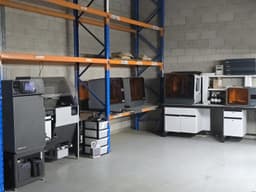
We print SLS parts on a Formlabs Fuse 1 in our Sydney workshop. A laser fuses glass-filled nylon powder one thin layer at a time, and the loose powder around each part holds it up as it prints. Nothing needs supports, so there are no marks to sand off.
Printed in Sydney, usually within 1–3 business days, and shipped Australia-wide.
How SLS works
An SLS printer keeps a chamber of nylon powder just below its melting point. A recoater spreads a 0.11 mm layer of powder across the bed, and a laser traces the slice of every part in that layer, fusing the grains to each other and to the layer below.
Then the bed drops, more powder goes on and the laser draws the next slice. A full build is a few thousand layers, and anything the laser didn't touch stays loose.
Why nothing needs supports
Nylon melts at about 180 °C but doesn't set until it cools to about 150 °C. The printer holds the whole chamber in that gap until the build is done, so each new layer stays flat while the loose powder around it carries its weight. Overhangs, and even parts nested inside other parts, print with nothing holding them up but powder.
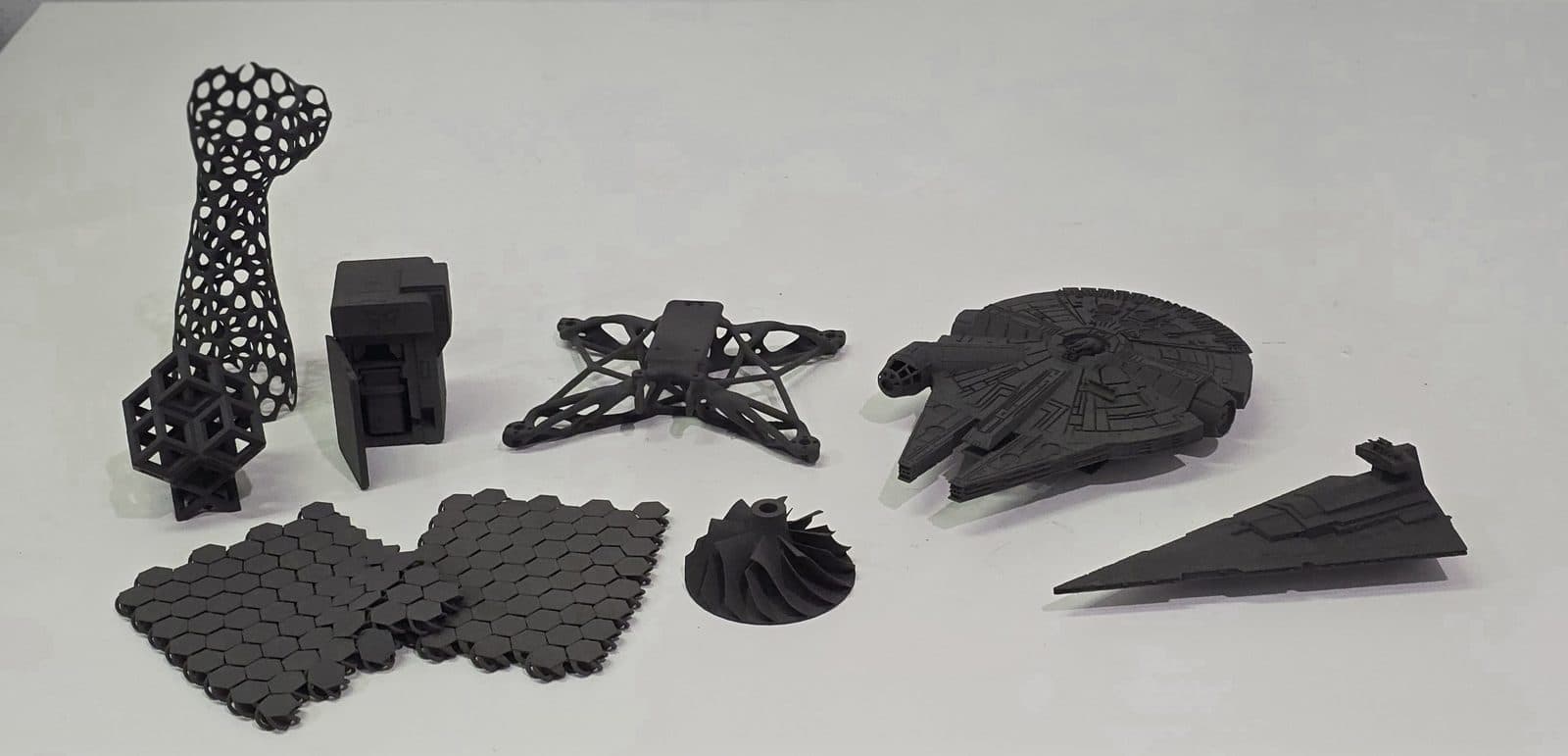
That's how SLS prints working hinges and chains, closed channels and fine lattices. The surface is a fine sandy matte rather than a shine, so if a part is mostly for show, resin will look better for the money.
One layer at a time
The printer repeats this loop for every layer. After the last one, the chamber cools slowly before we open it, because a part that cools unevenly warps.
Packing a build
Heating and cooling the chamber takes about as long for one part as for forty, and the cooling alone can take half as long as the print. So we fill every build, leaving at least 5 mm of powder between parts.
That's why SLS gets cheaper per part as your order grows. On the quote page, the rate per gram drops as you add more SLS parts.
Getting the parts out
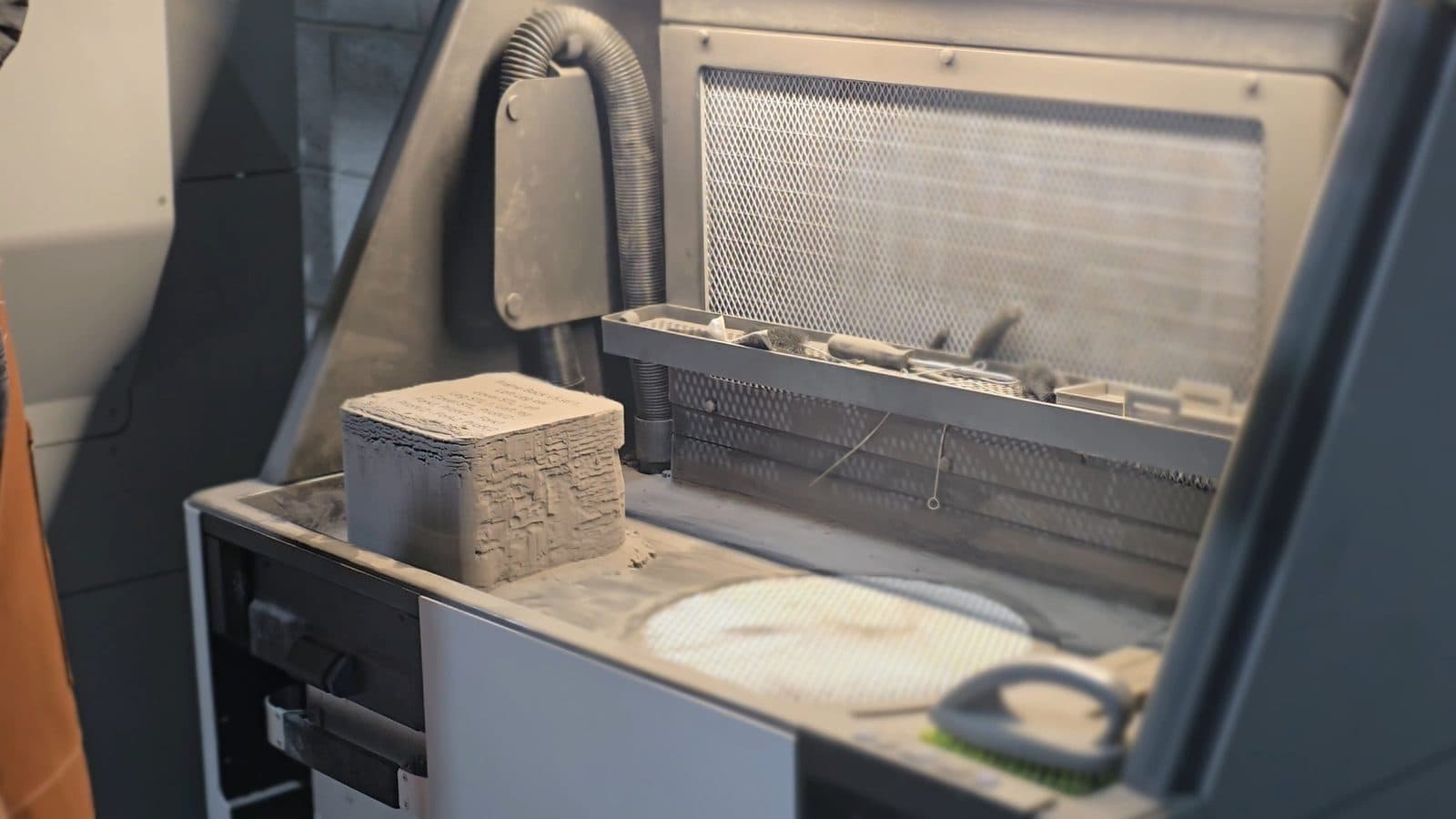
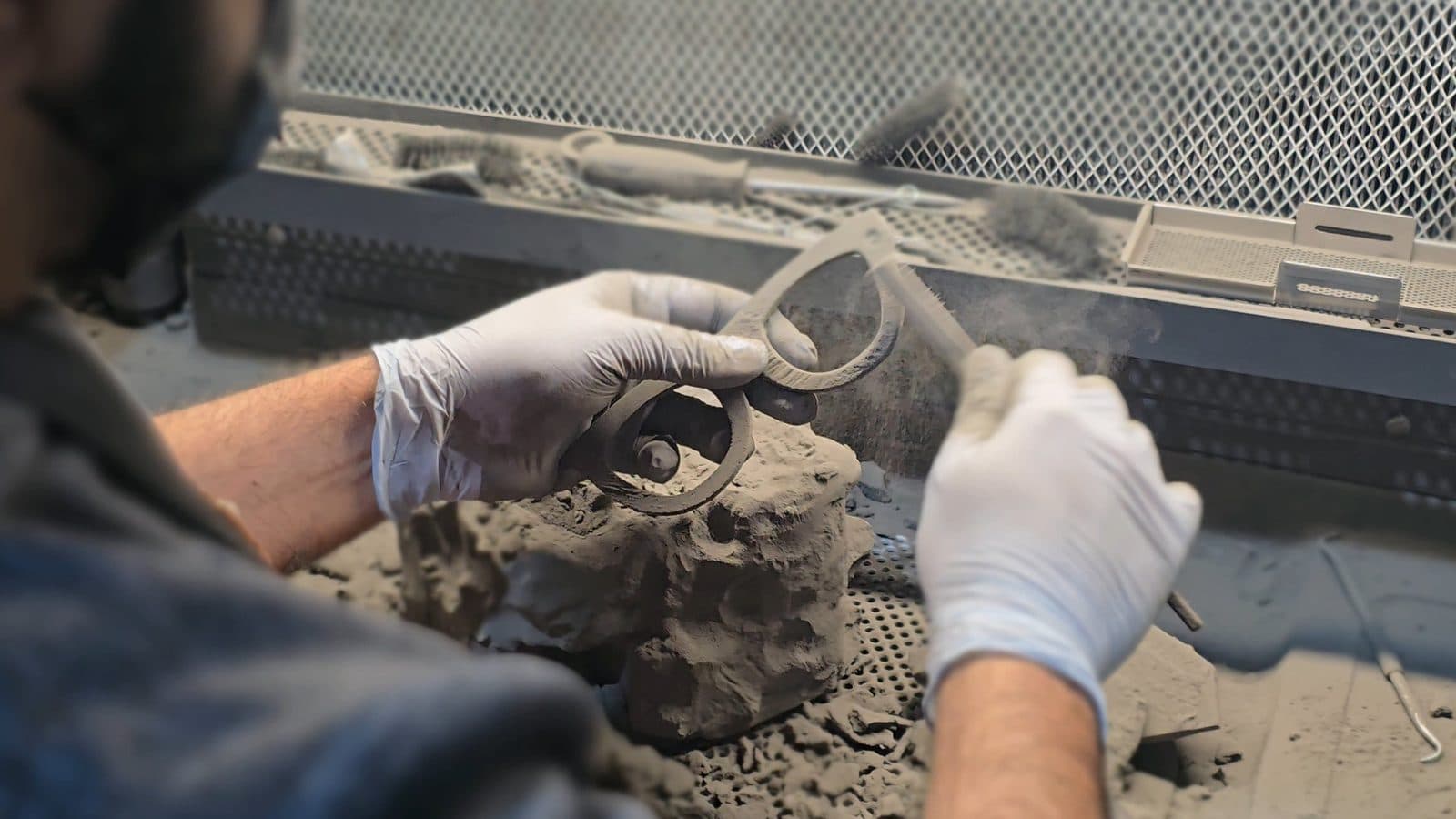
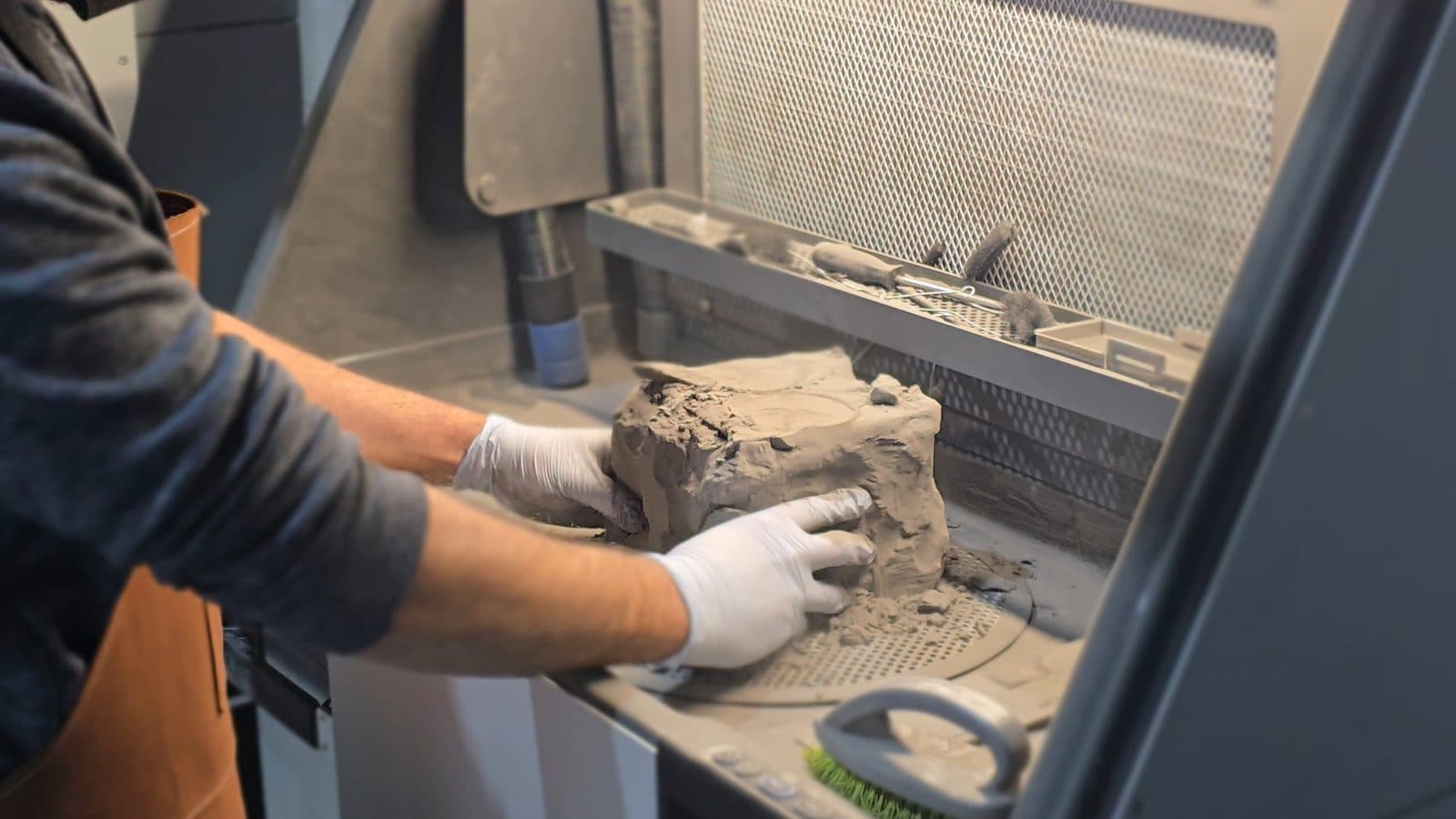
Once it has cooled, the whole block comes out in one piece. We break the parts out by hand and brush off the loose powder, which is sieved and reused in the next build.
Every part is then media blasted to clear powder from holes and corners and even out the surface.
What Nylon 12 GF is like
Nylon 12 GF is nylon with glass mixed through it, which makes it stiff and helps it keep its shape when warm. It isn't stronger than PLA when pulled, but it stays rigid near heat and is nearly as strong standing up as lying flat.
It snaps rather than bends, so keep clips and load-bearing ribs at a sensible thickness.
| Property | Figure | What it means |
|---|---|---|
| Tensile strength | 38 MPa | About the same as PLA |
| Stiffness (tensile modulus) | 2,800 MPa | Rigid; it won't flex much |
| Stretch before breaking | 4% flat, 3% standing up | Snaps rather than bends |
| Heat under load | 113 °C at 1.8 MPa, 170 °C at 0.45 MPa | Fine beside a motor or in a hot car |
| Impact (notched Izod) | 36 J/m | Takes knocks better than standard resin |
Jigs, fixtures and mounts
Nylon 12 GF is a good choice for jigs, fixtures and mounts. It's stiff, so parts hold their position, and it won't soften next to a warm motor.
Designing a part for SLS
Keep walls at least 1.5 mm thick, and give anything hollow a couple of escape holes so we can clear the loose powder out. Large flat parts can warp as they cool, and a few ribs underneath help keep them flat.
The table below has the sizes we recommend.
| Feature | Recommended |
|---|---|
| Wall thickness | 1.5 mm, and never under 0.6 mm |
| Pins | At least 1 mm across |
| Holes | At least 1.5 mm across |
| Escape holes in a hollow part | Two or more, each at least 3.5 mm across |
| Gap between separate parts that fit together | 0.5 to 0.7 mm |
| Gap for parts printed already assembled | 0.6 mm |
| Raised text | 4.5 mm tall, about 1 mm proud |
| Engraved text | 3 mm tall, about 1 mm deep |
Example price
A real quote from our quote page. Your price depends on your part's size, material and settings, so upload your file for an exact price.
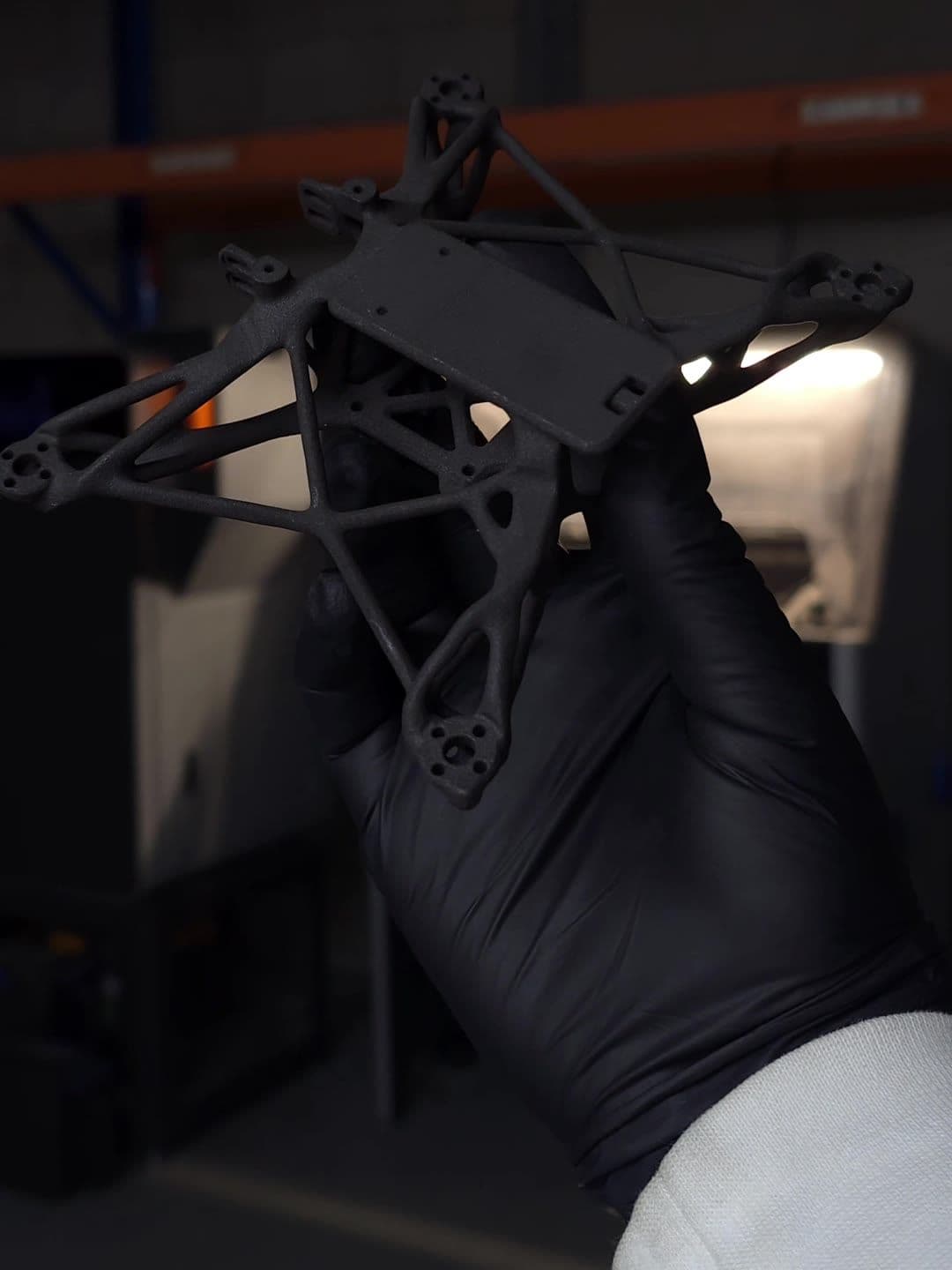
Drone frame
$36.92
for 1 part
- Material
- Nylon 12 GF, black
- In bulk
- $527.81 for 50, which is $10.56 each with the 8% bulk discount
Includes the one-off setup charge. Standard shipping $9.95 Australia-wide, free on orders of $50 or more. Quoted in October 2026; prices can change.
Material
Nylon 12 GF
Stiff, heat-resistant glass-filled nylon
Nylon 12 GF is a glass-filled SLS nylon: about 50% stiffer than standard Nylon 12, with a heat deflection temperature of 113 °C. Suitable for rigid structural parts, jigs, fixtures and parts exposed to heat. Thin or delicate features are more prone to breaking than in unfilled nylon.
Colours:BlackDark Gray
Colours shown on the quote page are the ones in stock today.
Specifications
- Printer
- Formlabs Fuse 1
- Maximum part size
- 165 × 165 × 300 mm
- Material
- Nylon 12 GF (glass-filled nylon)
- Layer height
- 0.11 mm
- Supports
- None needed
- Accuracy
- ±0.5%, or ±0.3 mm on small parts
- Finish
- Media blasted, fine matte texture
- File formats
- STL, STEP, OBJ, 3MF, GLB and GLTF, up to 50 MB
SLS, resin and FDM compared
Not sure this is the right method? Upload your file and every method shows a starting price, so you can weigh them up.
| SLS 3D Printing | Resin 3D Printing | FDM 3D Printing | |
|---|---|---|---|
| How it builds | A laser fuses nylon powder | A laser hardens liquid resin | A hot nozzle lays down melted plastic |
| Layer height | 0.11 mm | 0.1 mm | 0.2 mm, down to 0.12 mm |
| Supports | None | Thin supports, leaving small marks | Only under steep overhangs |
| Surface | Fine sandy matte | Smooth, layers hard to see | Visible layer lines |
| Strength by direction | Nearly the same every way | The same every way once cured | Weakest across the layers |
| Handles heat | Well, 113 °C under load | Poorly, in standard resin | 54 °C (PLA) to 92 °C (ASA) under load |
| Accuracy | ±0.5%, at least ±0.3 mm | ±0.5%, at least ±0.2 mm | ±0.5%, at least ±0.5 mm |
| Largest part | 165 × 165 × 300 mm | 335 × 200 × 320 mm | 400 × 400 × 400 mm |
| Best for | Working parts, moving assemblies, short runs | Display models, fine detail, mould masters | Low-cost prototypes, big parts, jigs |
SLS 3D Printing questions
Does SLS printing need support structures?
What is Nylon 12 GF?
What colours can I get?
How big can an SLS part be?
How is SLS 3D printing priced?
More answers on our FAQ page.
More from the workshop
Get your SLS 3D Printing price
Upload your 3D model and see the price in seconds. No account needed.
Get an instant quote